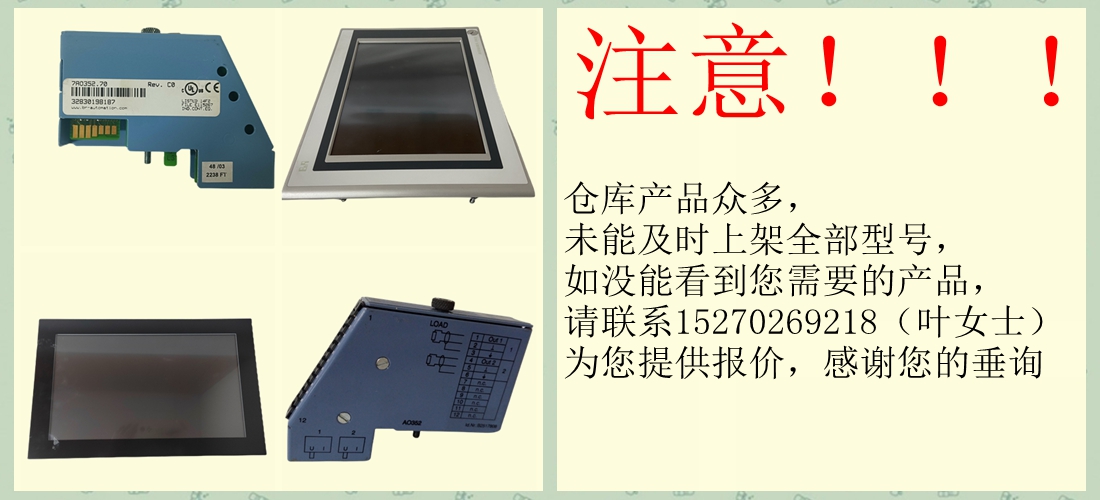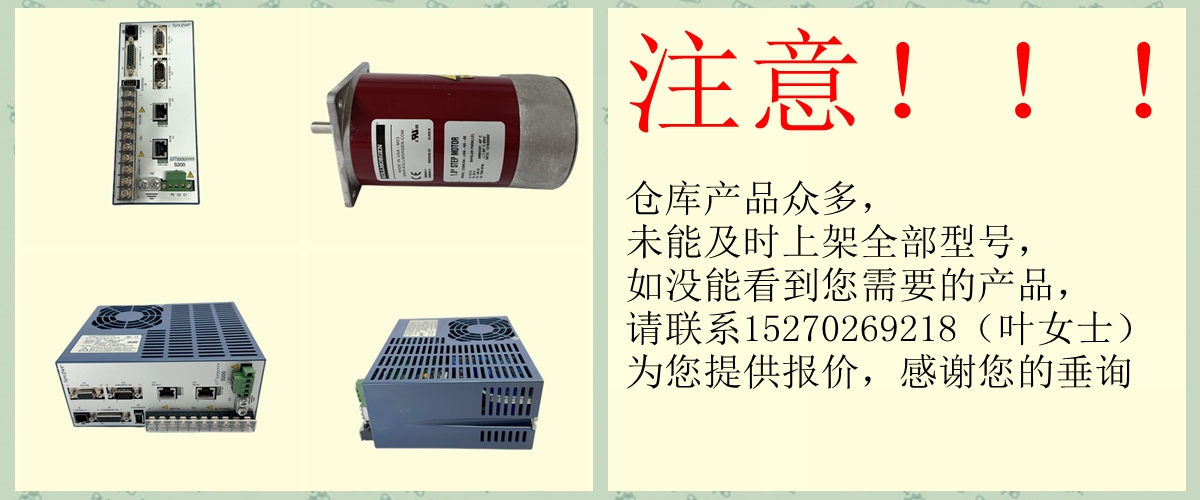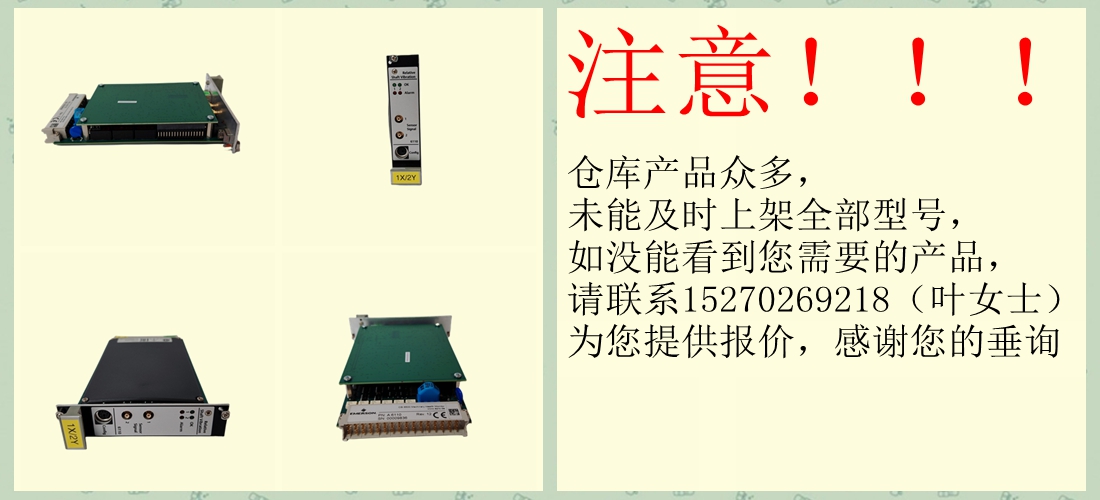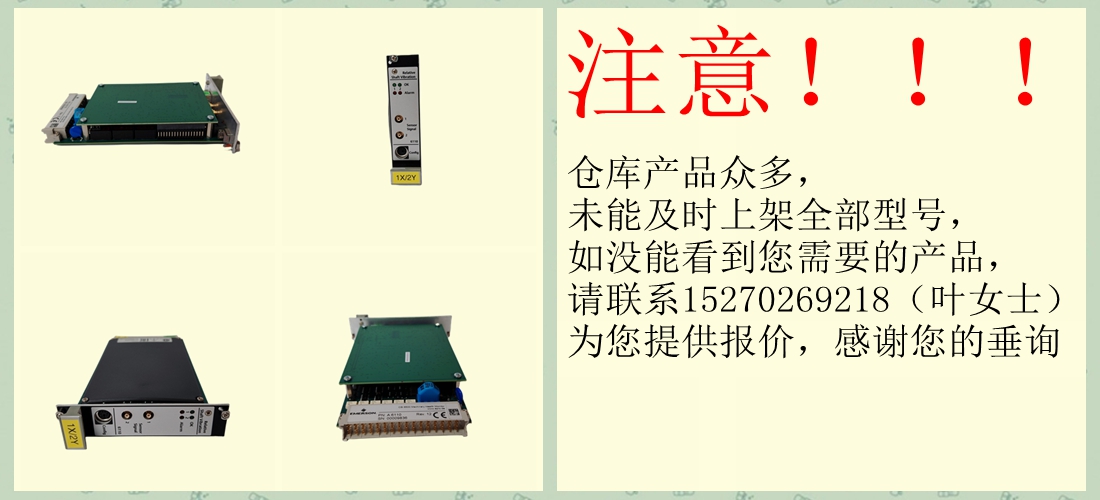


1MYN743219-A 1MYN26600-003 继电器单元 ABB
有六个模拟输出。每个输出可以设置电压或电流。每个模拟
数字/模拟转换器的输出是电压。这分为两个输出,其中一个
一个被转换为电流输出,另一个被保持为电压。如图2-12所示
其中例如X4:1是电压输出,X4:2是电流输出。
电压输出的允许负载电流大为5 mA。
电流输出的允许负载电阻大为550欧姆。
图2-12显示了连接用于电压输出的AO1和连接用于电流输出的AO2。
图2-12.连接模拟输出
附录中称重传感器电缆图的类型
PFCL 301E B
PFTL 301E C
PFRL 101 D
PFTL 101 E
PFCL 201 F
PFTL 201克
电压
D/A转换器
12
AO1
AO2
参见电路图
对于AO1和AO2
大550
输出
输出
大5 mA
张力电子PFEA113,用户手册
第2.10节连接模拟输入(AI1-AI2)
3BSE029382R0101版本C 2-13
2.10连接模拟输入(AI1-AI2)
两个模拟输入AI1和AI2是信号范围为0-10V的差分输入。
图2-13.连接模拟输入
2.11连接数字输出(DO1-DO4)
四个数字输出DO1-DO4作为一组绝缘。参见图2-14。
数字输出为电流驱动,可从外部24 V DC或
用于PFEA113的24V直流电源。
状态“1”下的电流大为每输出0.1 A。
图2-14.连接数字输出
2.12连接数字输入(DI)
数字输入是具有以下数据的差分输入:
无源:-36 V至+5 V
有效:大于16 V(大+36 V)
图2-15.连接数字输入
PFEA113
PFEA113
PFEA113
张力电子PFEA113,用户手册
第二章安装
2-14 3 BSE029382R0101版本C
2.13连接可选单元
2.13.1绝缘放大器PXUB 201
绝缘放大器PXUB 201用于输入和输出之间的电绝缘,或
在电源和输入/输出之间。参见第A.6.1节绝缘放大器
PXUB 201。
绝缘放大器PXUB 201旨在安装在DIN导轨上。PXUB 201是
通过螺钉端子连接。
PXUB 201通常由提供张力的+24 V直流电源供电
电子学
如果PXUB 201安装在端子组附近,则无需使用屏蔽电缆
在张力电子设备和PXUB 201之间。
图2-16绝缘放大器PXUB 201的典型连接
2.13.2继电器板PXKB 201
PFEA113上的数字输出作为一组隔离,不应连接到更多
而不是24V DC。在以下应用中,继电器应连接到数字输出:
•数字输出必须相互隔离。
•上级系统的信号高于24V直流或交流信号。
PXKB 201用于安装在DIN导轨上。
表2-4.PXKB 201的真值表。
A1(+)和A2(-)之间连接的输入信号
数字输入低(0 V)11和12
数字输入高(24 V)11和14
示例:AO1(另见附录B、C、D、E、F或G中的电缆图)
电压输出
AO1-AO6
张力电子PFEA113,用户手册
第2.13.3节电源装置SD83x
3BSE029382R0101版本C 2-15
图2-17 PXKB 201电路图
2.13.3电源单元SD83x
如果没有24V可用,电源单元SD 831、SD 832和SD 833可以用作
IP 20版本的电源。
电源装置拟安装在DIN导轨上。
所有三个电源单元的主电源电压为:
•115伏交流电(90-132伏),100伏-10%至120伏+10%
•230伏交流电(180-264伏),200伏-10%至240伏+10%
表2-5.可提供的PFEA113数量
电源装置PFEA113备注
SD 831(3 A)3不包括数字输出的供应
SD 832(5 A)6不包括数字输出的供应
SD 833(10 A)12不包括数字输出的供应
张力电子PFEA113,用户手册
第二章安装
2-16 3 BSE029382R0101版本C
张力电子PFEA113,用户手册
关于本章的第3.1节
3BSE029382R0101版本C 3-1
第三章调试
3.1关于本章
本章包含调试卷筒纸张力系统所需的信息。
假设腹板张力系统已按照给出的说明安装
在第2章安装和附录(B、C、D、E、F或G)中,取决于已安装的称重传感器
类型
开始调试前,您必须具备以下数据:
1.称重传感器类型和标称荷载,安装的称重传感器类型见附录
2.系统定义见第3.12.2节。
•称重传感器组合
–一卷(称重传感器A和B)
–两卷(
1MYN743219-A 1MYN26600-003 继电器单元 ABB
1MYN743219-A 1MYN26600-003 继电器单元 ABB
There are six analog outputs. Each output can be set either for voltage or current. Each analog
output from the digital/analog converter is a voltage. This is split into two outputs, one of which
is converted into a current output and the other kept as voltage. This is illustrated in Figure 2-12
where for example X4:1 is the voltage output and X4:2 is the current output.
The allowed load current of the voltage output is max. 5 mA.
The allowed load resistance of the current output is max. 550 ohms.
Figure 2-12 shows AO1 connected for voltage output and AO2 for current output.
Figure 2-12. Connecting Analog Outputs
Type of load cell Cable diagrams in Appendix
PFCL 301E B
PFTL 301E C
PFRL 101 D
PFTL 101 E
PFCL 201 F
PFTL 201 G
Voltage
D/Aconverter
12
AO1
AO2
See circuit diagram
for AO1 and AO2
Max. 550
output
output
Max. 5 mA
Tension Electronics PFEA113, User Manual
Section 2.10 Connecting Analog Inputs (AI1-AI2)
3BSE029382R0101 Rev C 2-13
2.10 Connecting Analog Inputs (AI1-AI2)
The two analog inputs, AI1 and AI2, are differential inputs with a signal range of 0-10 V.
Figure 2-13. Connecting Analog Inputs
2.11 Connecting Digital Outputs (DO1-DO4)
The four digital outputs, DO1-DO4, are insulated as a group. See Figure 2-14.
The digital outputs are current driving and can be supplied from an external 24 V DC or from
the 24 V DC supply used for PFEA113.
The current at state “1” is maximum 0.1 A per output.
Figure 2-14. Connecting Digital Outputs
2.12 Connecting the Digital Input (DI)
The digital input is a differential input with the following data:
Passive: -36 V to +5 V
Active: >16 V (maximum +36 V)
Figure 2-15. Connecting the Digital Input
PFEA113
PFEA113
PFEA113
Tension Electronics PFEA113, User Manual
Chapter 2 Installation
2-14 3BSE029382R0101 Rev C
2.13 Connecting Optional Units
2.13.1 Insulation Amplifier PXUB 201
Insulation amplifier PXUB 201 is used when galvanic insulation between input and output, or
between power supply and input/output, is required. See Section A.6.1 Insulation Amplifier
PXUB 201.
Insulation amplifier PXUB 201 is intended for installation on a DIN-rail. The PXUB 201 is
connected by screw terminals.
PXUB 201 is normally supplied from the same +24 V DC supply that supplies the tension
electronics.
If PXUB 201 is mounted close to the terminal group, it is not necessary to use a screened cable
between the tension electronics and PXUB 201.
Figure 2-16. Typical Connection of Insulation Amplifier PXUB 201
2.13.2 Relay Board PXKB 201
The digital outputs on PFEA113 are isolated as a group and should not be connected to more
than 24 V DC. In the following applications should relays be connected to the digital outputs:
• The digital outputs must be isolated from each other.
• The signal to the superior system is higher than 24 V DC or an AC signal.
The PXKB 201 is intended for mounting on a DIN-rail.
Table 2-4. Truth table PXKB 201.
Input signal to A1(+) and A2(-) Connection between
Digital input low (0 V) 11 and 12
Digital input high (24 V) 11 and 14
Example: AO1 (see also cable diagrams in Appendix B, C D, E, F or G)
Voltage Output
AO1-AO6
Tension Electronics PFEA113, User Manual
Section 2.13.3 Power Supply Unit SD83x
3BSE029382R0101 Rev C 2-15
Figure 2-17. Circuit diagram PXKB 201
2.13.3 Power Supply Unit SD83x
If no 24 V is available, the power supply units SD 831, SD 832 and SD 833 can be used as
power supplies for the IP 20-versions.
The power supply unit is intended to be installed on a DIN-rail.
The main supply voltage for all the three power supply units are:
• 115 V AC (90 - 132 V), 100 V -10% to 120 V + 10%
• 230 V AC (180 - 264 V), 200 V -10% to 240 V + 10%
Table 2-5. Number of PFEA113 that can be supplied
Power Supply Unit PFEA113 Remarks
SD 831 (3 A) 3 Supply of digital outputs not included
SD 832 (5 A) 6 Supply of digital outputs not included
SD 833 (10 A) 12 Supply of digital outputs not included
Tension Electronics PFEA113, User Manual
Chapter 2 Installation
2-16 3BSE029382R0101 Rev C
Tension Electronics PFEA113, User Manual
Section 3.1 About this Chapter
3BSE029382R0101 Rev C 3-1
Chapter 3 Commissioning
3.1 About this Chapter
This chapter contains the information needed to commission a Web Tension System.
It is assumed that the Web Tension System has been installed according to the instructions given
in Chapter 2 Installation and Appendix (B, C, D, E, F or G) depending on installed load cell
type.
You must have the following data before starting commissioning:
1. Load cell type and nominal load, see Appendix for installed load cell type
2. System definition, see Section 3.12.2.
• Load cell combination
– One roll (load cells A and B)
– Two rolls (
1MYN743219-A 1MYN26600-003 继电器单元 ABB