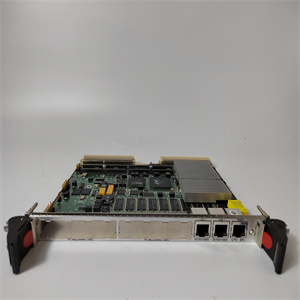
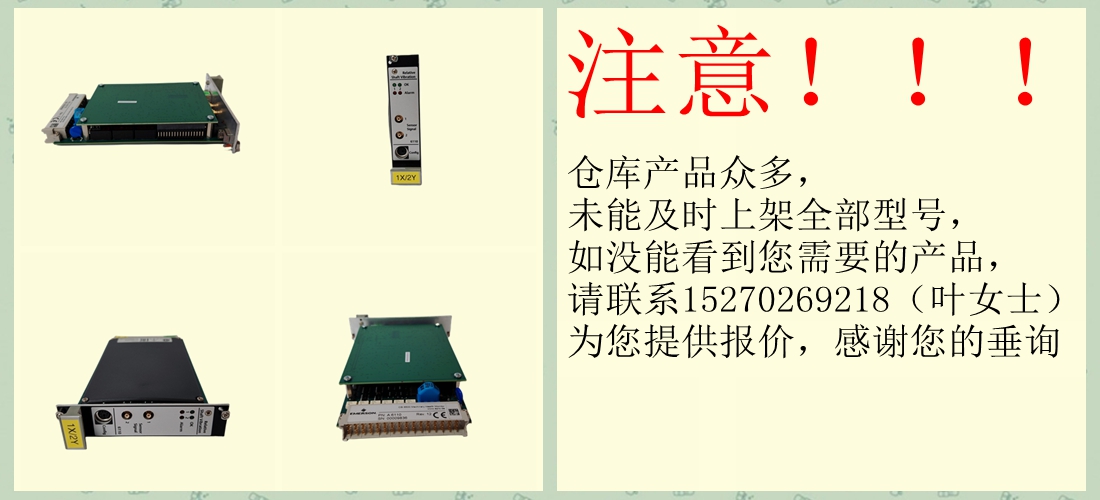
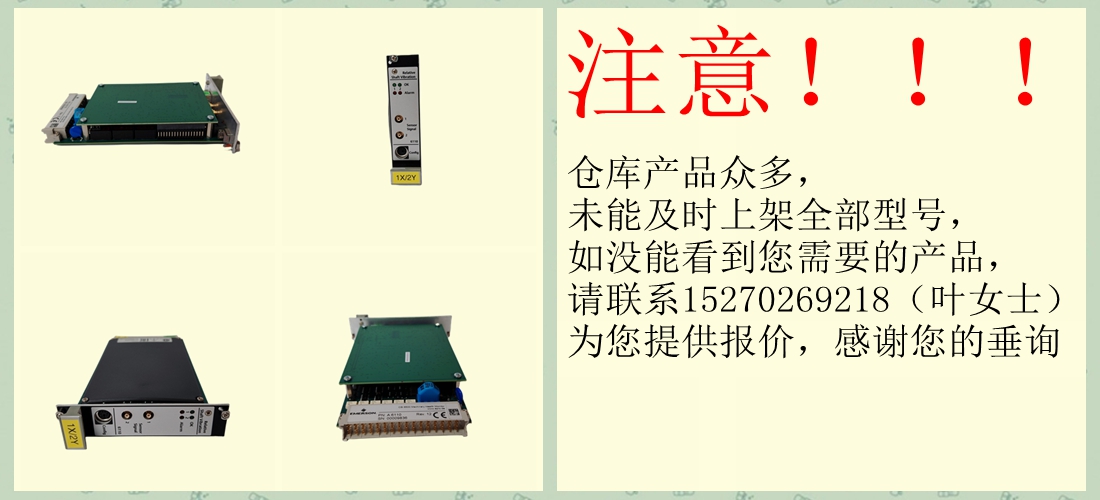
81EA02E GJR2366000R1000 81EA02D-E 伺服驱动板 ABB

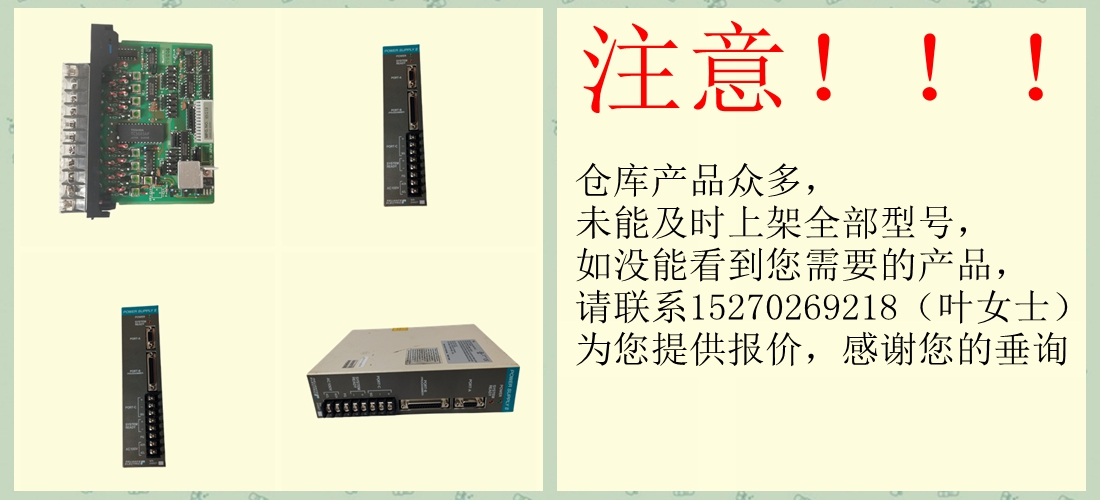
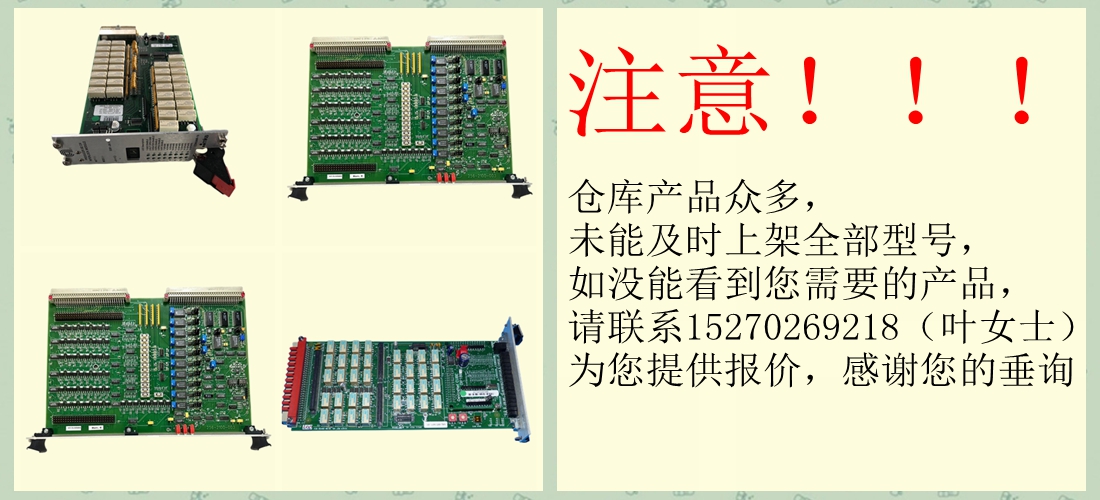
88VU01E GJR2326500R1000 88VU01B-E 控制主板 ABB
本附录描述了称重传感器安装的设计程序。
包括以下部分:
•基本应用考虑
•设计称重传感器安装(分步指南)
•安装要求
•力和缠绕增益计算
–水平安装
–倾斜安装
–单侧测量
•安装称重传感器
•技术数据
•图纸
–电缆图
–尺寸图
F、 2.基本应用注意事项
每个应用程序都有其必须考虑的单独需求;虽然有一些基本的
考虑因素往往会重复。
•涉及什么类型的工艺(造纸、加工等)?
环境要求(温度、化学品等)高吗?
•张力测量的目的是什么;指示或闭环控制?
是否有任何具体的精度要求?
•机器设计如何?是否有可能修改设计,
为了安装合适的称重传感器,还是机器设计固定?
•作用在辊上的力是什么(大小和方向)?
它们可以通过重新设计进行更改吗?
如果彻底解决这些问题,安装很可能会成功。
然而,需要测量精度的程度定义了以下要求:
设计称重传感器装置。
张力电子PFEA113,用户手册
附录F PFCL 201-称重传感器安装设计
F-2 3BSE029382R0101 C版
F、 3.设计称重传感器安装的分步指南
以下程序定义了设计称重传感器时涉及的主要考虑因素
安装
1.检查称重传感器数据,以满足环境要求。
2.计算力;垂直、水平和轴向(横向)。
3.称重传感器的尺寸和方向应符合以下指南:
a、 试着在称重传感器中获得不小于腹板张力10%的测量值
测量方向!
b、 选择称重传感器尺寸,使其负载尽可能接近其标称负载!做
测量方向上张力的非尺寸力分量,FR,小于
称重传感器标称负载的10%!
c、 如果过程中大张力和小张力之间的跨度较大,请选择
称重传感器,使大张力处于称重传感器延伸范围内(当
适用)!
d、 建议测得的腹板张力分力至少为以下值的30%:
沿称重传感器测量方向作用的皮重分力(辊重)。这个
此建议的原因是称重传感器信号的稳定性,尤其是当
系统在大的温度范围内运行。
这意味着如果FRT
对于较大的FRT,建议低FR至少为FRT的30%。
e、 检查称重传感器数据,以便建筑物高度、横向力和轴向力的限值为
不超过。
4.设计基架和/或转接板。
次登记税
T T
FR
100%
规则1:
> 30%
FR=测量方向上腹板张力的分力
FRT=测量方向上的皮重力
如果FRTFR应至少为Fnom的10%
规则2:如果FRT>Fnom的1/3
建议FR至少为FRT的30%
张力电子PFEA113,用户手册
第F.4节安装要求
3BSE029382R0101版本C F-3
F、 4安装要求
为了达到规定的精度、佳的可靠性和长期稳定性,安装
称重传感器应符合以下要求。
图F-1.安装要求
可以放置垫片
在上部适配器之间
板和轴承箱
以及下适配器之间
称重传感器的校准
称重传感器。
上下
不得放置垫片
板和基础。
网状物
为了正确的拧紧力矩,
见表F-1和
88VU01E GJR2326500R1000 88VU01B-E 控制主板 ABB
88VU01E GJR2326500R1000 88VU01B-E 控制主板 ABB
This appendix describes the procedure for designing the load cell installation.
The following sections are included:
• Basic application considerations
• Designing the load cell installation (step-by-step guide)
• Installation requirements
• Force and wrap gain calculation
– Horizontal mounting
– Inclined mounting
– Single side measurement
• Mounting the load cells
• Technical data
• Drawings
– Cable diagram(s)
– Dimension drawing(s)
F.2 Basic Application Considerations
Each application has its own individual demands that have to be considered; though a few basic
considerations tend to repeat themselves.
• What type of process is involved (papermaking, converting, etc.)?
Is the environment demanding (temperature, chemicals, etc.)?
• What is the tension measurement purpose; indication or closed loop control?
Are there any specific accuracy demands involved?
• What is the machine design like? Is there the possibility to modify the design,
in order to fit the most suitable load cell, or is the machine design fixed?
• What are the forces acting on the roll like (size and direction)?
Can they be altered by redesign?
If these questions are dealt with thoroughly, the installation is very likely to be successful.
However, the extent to which measurement accuracy is needed, defines the requirements when
designing a load cell installation.
Tension Electronics PFEA113, User Manual
Appendix F PFCL 201 - Designing the Load Cell Installation
F-2 3BSE029382R0101 Rev C
F.3 Step-by-Step Guide for Designing the Load Cell Installation
The procedure below defines the main considerations involved in designing a load cell
installation.
1. Check load cell data so that environmental demands are met.
2. Calculate forces; vertical, horizontal and axial (cross directional).
3. Size and orient load cell so that the guidelines below are met:
a. Try to achieve a measured value no less than 10% of web tension, in the load cell
measurement direction!
b. Select load cell size so that it is loaded as close as possible to its nominal load! Do
not dimension Force component of Tension in measuring direction, FR, for less than
10% of the load cell nominal load!
c. If the span between maximum and minimum tension in the process is large, select
load cell so that the maximum tension will be in the load cell extended range (when
applicable)!
d. The measured force component of web tension is recommended to be at least 30% of
tare force component (roll weight) acting in load cell measurement direction. The
reason for this recommendation is load cell signal stability, especially when the
system operates in a large temperature span.
This means that if FRT < 1/3 of Fnom, FR should be at least 10% of Fnom.
For larger FRT, lowest FR is recommended to be at least 30% of FRT.
e. Check load cell data so that limits for building height, transverse and axial forces are
not exceeded.
4. Design base frame and/or adapter plates.
FRT
T T
FR
100%
Rule 1:
> 30%
FR = Force component of web tension in measuring direction
FRT = Tare force in measurement direction
If FRT < 1/3 of Fnom
FR should be at least 10% of Fnom
Rule 2: If FRT > 1/3 of Fnom
FR is recommended to be at least 30% of FRT
Tension Electronics PFEA113, User Manual
Section F.4 Installation Requirements
3BSE029382R0101 Rev C F-3
F.4 Installation Requirements
To achieve the specified accuracy, the best possible reliability and long-term stability, install the
load cells in accordance with the requirements below.
Figure F-1. Installation requirements
Shims may be placed
between the upper adapter
plate and the bearing housing
and between the lower adapter
Alignment of the load cells
the load cell.
immediately above or below
Shims must not be placed
plate and the foundation.
Web
For correct tightening torques,
see Table F-1 an
88VU01E GJR2326500R1000 88VU01B-E 控制主板 ABB