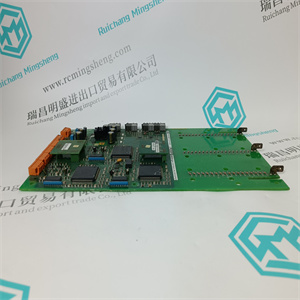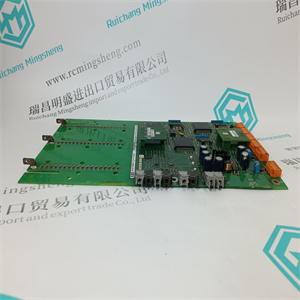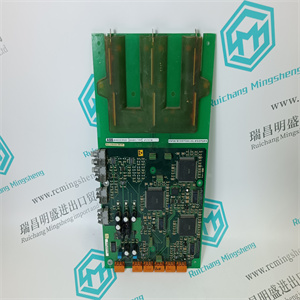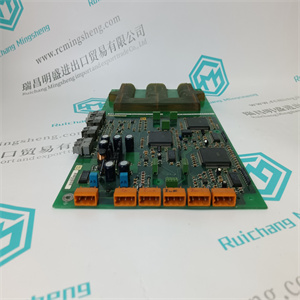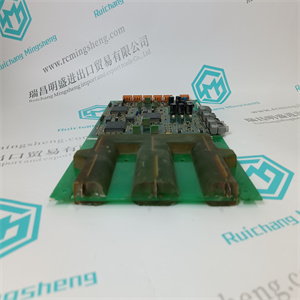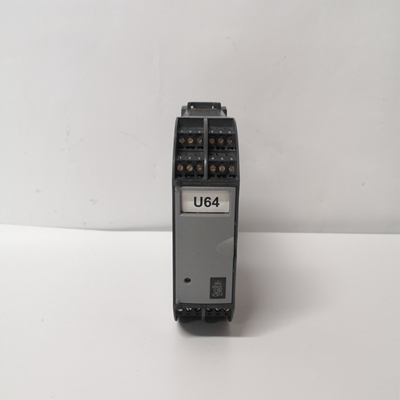

CMMTU02 用于自动化DCS监控数据传输模块 ABB
动态平衡
自动调心轴承
ISO 1940-1的G-2.5级。
这至少满足了
测量辊
使用SKF CARB轴承,
滑动球面滚子
或者作为第二选择,
为了允许轴向膨胀,
轴。
一端轴承
安装面
稳固的基础
如果测量辊被驱动,
始终咨询ABB以确保:
0.05毫米(0.002英寸)
干扰。
风险小化的解决方案
内部必须是平的
使用固定球面滚子
另一边的轴承
轴的端部。
张力电子PFEA113,用户手册
附录G PFTL 201-称重传感器安装设计
G-4 3BSE029382R0101 C版
G、 5种安装方案、计算力和计算缠绕增益
G、 5.1水平安装
在大多数情况下,水平安装为明显
简单的解决方案。因此,称重传感器应:
尽可能水平安装。
FR=T×(cos 余弦)
FRtot=FR+FRT=T× 余弦)
FRT=0(未测量皮重力)
缠绕增益T
FR
-------T
T 余弦 – 余弦 = = ------------------------------------------
卷绕增益1
余弦 – 余弦 = ---------------------------------
T(张力)缠绕增益FR=
FR T
+ +
杂草
张力电子PFEA113,用户手册
第G.5.2节倾斜安装
3BSE029382R0101版本C G-5
G、 5.2倾斜安装
有时需要将称重传感器安装在
由于机械设计限制而倾斜
机器或需要有足够的分力
应用于称重传感器。
倾斜安装在
测量方向并修改力分量
如图所示。
注
计算时,重要的是
设置为具有正确符号的方程式
相对于水平面。
FR=T×[cos() 因为()]
FRtot=FR+FRT=
次登记税=皮重×辛
T×[cos() 因为()] + (皮重×辛)
缠绕增益T
FR
-------T
T 余弦 + – 余弦 – = = ---------------------------------------------------------------------
T(张力)缠绕增益FR=
卷绕增益1
余弦 + – 余弦 – = ------------------------------------------------------------
杂草
次登记税
FR
T
T
+
杂草
次登记税
FR
T
T
+
+
水平面
张力电子PFEA113,用户手册
附录G PFTL 201-称重传感器安装设计
G-6 3BSE029382R0101 C版
G、 6.单测力传感器测量的力计算
在某些情况下,仅在一个传感器上安装一个称重传感器即可测量张力
卷的末尾。
G、 6.1常见和简单的解决方案
明显和简单的解决方案是水平安装,腹板均匀分布
并以辊为中心。
只要辊子两端支撑,第G.5节中给出的计算结果相同
有效的
注
单个称重传感器测量的精度在很大程度上取决于:
可以确定力的中心。由于横向应力
分布通常有些不均匀,这不容易做到。称重传感器
然而,将产生稳定和可重复的测量。
图G-2.横向应力分布
张力电子PFEA113,用户手册
第G.6.2节:腹板未位于辊中心时的力计算
3BSE029382R0101版本C G-7
G、 6.2腹板不在辊中心时的力计算
当腹板未居中时,使用以下计算进行水平和倾斜安装
在滚动。
称重传感器上施加的力将与张力之间的距离成比例
中心和称重传感器中心线,见图。
计算程序:
1.水平安装还是倾斜安装?
2.计算FR和FRT,见第G.5节。
3.使用以下等式:
单称重传感器的FR=
单称重传感器的FRT=
单称重传感器的FRtot=单称重传感器FR+单称重传感器FRT
哪里:
L=称重传感器中心线与相对轴承中心线之间的距离
a=皮重中心和称重传感器中心线之间的距离
b=拉力中心和称重传感器中心线之间的距离
b
一
L
皮重力中心
称重传感器
PFTL 201
张力中心
FR
L b——
L -----------
次登记税
洛杉矶——
L -----------
张力电子PFEA113,用户手册
附录G PFTL 201-称重传感器安装设计
G-8 3BSE029382R0101 C版
G、 7.安装称重传感器
G、 7.1准备工作
通过检查必要的文件和材料,及时准备安装
可用,如下所示:
•安装图纸和本手册。
•标准工具、扭矩扳手和仪器。
•防锈,如果对机加工表面进行额外保护。
例如,选择TECTYL 511(Valvoline)或FERRYL(104)。
•表G-1或表G-2中列出的用于固定称重传感器的螺钉,以及其他螺钉
用于轴承箱等。
•称重传感器、转接板、轴承箱等。
G、 7.2转接板
转接板通常应配备止动块,以防止移动,如果
称重传感器过载。大镰刀
CMMTU02 用于自动化DCS监控数据传输模块 ABB
CMMTU02 用于自动化DCS监控数据传输模块 ABB
Dynamically balanced
Self aligning bearings
Grade G-2.5 ISO 1940-1.
that fulfills at least
measuring roll
use SKF CARB bearings,
sliding spherical roller
or as a second choice,
To allow axial expansion,
the shaft.
bearings at one end of
Mounting surface
Stable foundation
If the measuring roll is driven,
always consult ABB to ensure
0.05 mm (0.002 in.)
of disturbances.
a solution with minimized risk
must be flat within
Use fixed spherical roller
bearings at the other
end of the shaft.
Tension Electronics PFEA113, User Manual
Appendix G PFTL 201 - Designing the Load Cell Installation
G-4 3BSE029382R0101 Rev C
G.5 Mounting Alternatives, Calculating Force and Calculating Wrap Gain
G.5.1 Horizontal Mounting
In most cases, horizontal mounting is the most obvious
and simplest solution. The load cell should thus be
mounted horizontally when possible.
FR = T × (cos cos )
FRtot = FR + FRT = T × (cos cos )
FRT = 0 (Tare force is not measured)
Wrap gain T
FR
------- T
T cos – cos = = ------------------------------------------
Wrap gain 1
cos – cos = ---------------------------------
T (Tension) Wrap gain FR =
FR T
+ +
Tare
Tension Electronics PFEA113, User Manual
Section G.5.2 Inclined Mounting
3BSE029382R0101 Rev C G-5
G.5.2 Inclined Mounting
Sometimes it is necessary to mount the load cell on an
incline due to mechanical design constraints of the
machine or the need to have a sufficient force component
applied to the load cell.
Inclined mounting adds a component of tare force in the
measuring direction and modifies the force components
as shown.
NOTE
When calculating, it is important that the angles
are set into the equations with the correct signs
in relation to the horizontal plane.
FR = T × [cos() cos()]
FRtot = FR + FRT =
FRT = Tare × sin
T × [cos() cos()] + (Tare × sin )
Wrap gain T
FR
------- T
T cos + – cos – = = ---------------------------------------------------------------------
T (Tension) Wrap gain FR =
Wrap gain 1
cos + – cos – = ------------------------------------------------------------
Tare
FRT
FR
T
T
+
Tare
FRT
FR
T
T
+
+
Horizontal plane
Tension Electronics PFEA113, User Manual
Appendix G PFTL 201 - Designing the Load Cell Installation
G-6 3BSE029382R0101 Rev C
G.6 Force Calculation for Measurement with a Single Load Cell
In some cases, it is sufficient to measure the tension with only a single load cell mounted at one
end of the roll.
G.6.1 The Most Common and Simple Solution
The most obvious and simple solution is horizontal mounting with the web evenly distributed
and centered on the roll.
As long as the roll is supported at both ends, the same calculations given in Section G.5 are
valid.
NOTE
The accuracy of a single load cell measurement is highly dependent on how well
the center of force can be determined. Since the cross-directional stress
distribution generally is somewhat uneven, this is not easily done. The load cell
will, however, produce a stable and repeatable measurement.
Figure G-2. Cross-directional stress distribution
Tension Electronics PFEA113, User Manual
Section G.6.2 Force Calculation when the Web is not Centered on the Roll
3BSE029382R0101 Rev C G-7
G.6.2 Force Calculation when the Web is not Centered on the Roll
Use the calculations below for horizontal and inclined mounting when the web is not centered
on the roll.
The applied force at the load cell will be proportional to the distance between the tension force
center and the load cell centerline, see figure.
Calculation procedure:
1. Horizontal or inclined mounting?
2. Calculate FR and FRT, see Section G.5.
3. Use the following equations:
FR for single load cell =
FRT for single load cell =
FRtot for single load cell = FR for single load cell + FRT for single load cell
where:
L = Distance between load cell centerline and the opposite bearing centerline
a = Distance between tare force center and load cell centerline
b = Distance between tension force center and load cell centerline
b
a
L
Tare force center
Load cell
PFTL 201
Tension force center
FR
L b –
L -----------
FRT
L a –
L -----------
Tension Electronics PFEA113, User Manual
Appendix G PFTL 201 - Designing the Load Cell Installation
G-8 3BSE029382R0101 Rev C
G.7 Mounting the Load Cells
G.7.1 Preparations
Prepare the installation in good time by checking that the necessary documents and material are
available, as follows:
• Installation drawings and this manual.
• Standard tools, torque wrench and instruments.
• Rust protection, if additional protection is to be given to machined surfaces.
Choose TECTYL 511 (Valvoline) or FERRYL (104), for example.
• Screws as listed in Table G-1 or Table G-2 to secure the load cell, and other screws
for bearing housings etc.
• Load cells, adapter plates, bearing housings, etc.
G.7.2 Adapter plates
The adapter plates shall normally be provided with stop blocks in order to prevent movement, if
the load cells are overloaded. The screw joints may not alone fix the load cells in a proper way
at overload. See drawing in Section G.17 and Section G.18.
G.7.3 Mounting
The instructions below apply to a typical mounting arrangement. Variations are allowed,
provided that the requirements of Section G.4 are complied with.
1. Clean the foundation and other mounting surfaces.
2. Fit the lower adapter plate to the load cell. Tighten the screws to the torque stated in
Table G-1 or Table G-2 and lock them with locking fluid.
3. Fit the load cell and the lower adapter plate to the foundation, but do not fully tighten the
screws.
4. Fit the upper adapter plate to the load cell, tighten to the torque stated in Table G-1 or
Table G-2, and apply locking fluid.
5. Fit the bearing housing and the roll to the upper adapter plate, but do not fully tighten the
screws.
6. Adjust the load cells so that they are in parallel with each other and in line with the axial
direction of the roll. Tighten the foundation screws.
7. Adjust the roll so that it is at right angles to the longitudinal direction of the load cells.
Tighten the screws in the upper adapter plate.
8. Apply rust protection to any machined surfaces
CMMTU02 用于自动化DCS监控数据传输模块 ABB